Cal. DD4131 / DD4130
VS Factory (VSF) Rolex Cosmograph Daytona Collection
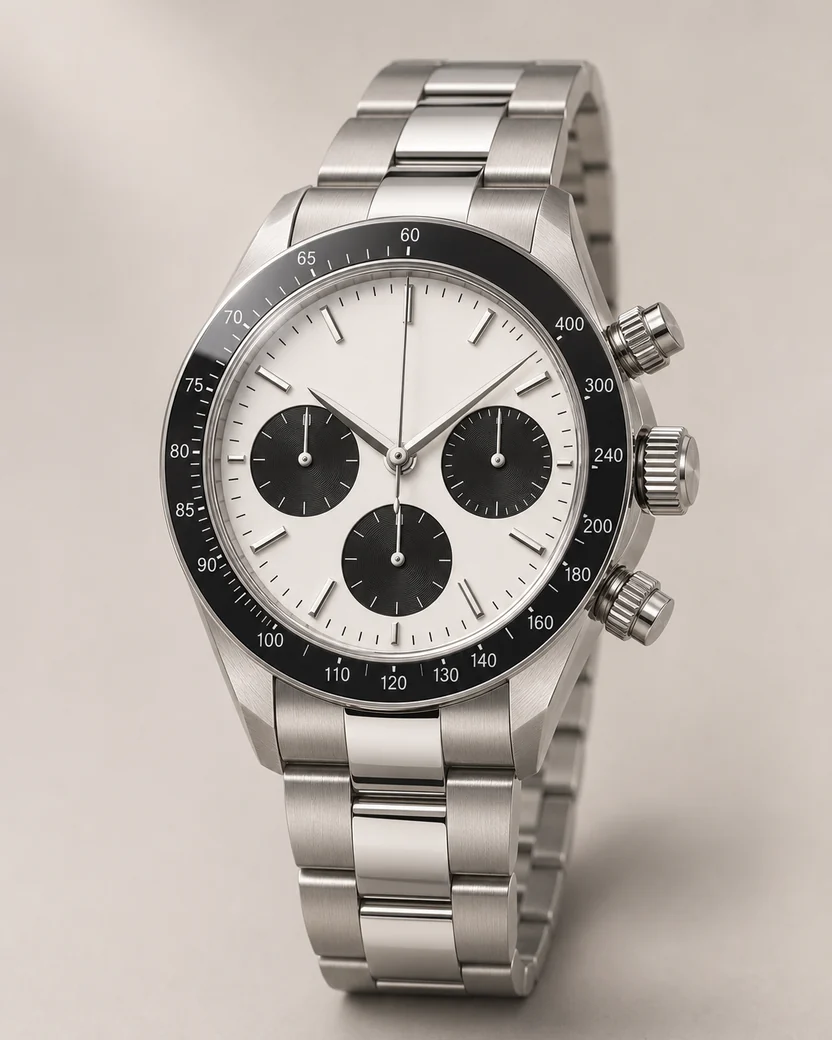
The Daytona collection compares chronograph reference families before comparing their dial colours or bracelet choices. The 126500 group is associated here with DD4131 and the 116500 group with DD4130. Check the subdial layout, pusher operation and case profile together to understand which features belong to a specific build. The useful record includes both the stopped and reset positions.
Catalog products
Product listings are being prepared for this collection.
Ask about a referenceMovement & case architecture
A chronograph has three distinct operations worth recording. Start the center seconds hand, stop it after the counters have had time to move, then reset and watch where the hands land. Repeat the cycle before calling an uneven landing a fault. Provide a side view so the shape and seating of the pushers can be judged at the same time. A dial photo alone will not show how they operate.
When following a DD4131 or DD4130 designation, match it to a movement image or the stated supplier record. The position and design of bridges can be useful visual clues. Thickness measurements need a defined start and end point because the crystal and case back each contribute. Photograph the measuring points and specify whether the watch was held flat. Case weight also varies with the bracelet or strap fitted.
Collector’s benchmark
Black-on-white and reverse-colour dials should be compared under the same exposure. Study the spacing of the counter rings and the visibility of each hand against its subdial. Assess how the main chronograph hand lines up at rest, ideally directly above the 12 o’clock marker. An angled photograph can exaggerate a small parallax effect because the hand sits above the printed scale.
Compare control feel without forcing a threaded cap or pusher. A collector can note whether the response feels immediate and whether the control returns cleanly. Where a case is described as weighted, ask how the recorded weight was obtained, with the strap or bracelet and links accounted for. The reported figure describes the pictured configuration and should not be used to infer the metal composition.
VSF Daytona FAQs
What is the simplest functional comparison for a Daytona?
Use one uninterrupted start-stop-reset video. Include the running display and enough time for an elapsed counter to move, then observe where each hand comes to rest.
How should I compare case thickness?
Measure each watch vertically between consistent points on the back and crystal, and record those points. Small differences can come from the measurement technique as well as case shape.
When should the chrono dial be rephotographed?
Ask for another image if the camera angle or reflection hides an elapsed counter, or if a hand appears off its index. The follow-up should match the same watch and zoom out enough to show the outer scale. Check the start, stop and reset sequence before treating the photo as a functional diagnosis.